
Water Leak Detection for Commercial Buildings
Wed, 14 Oct 2026
A water bill that climbs without a clear change in occupancy is rarely just an accounts issue. It can be the first visible sign of a concealed leak under a slab, above a ceiling grid, inside a plant room or across an ageing irrigation network. Effective water leak detection for commercial buildings gives facility managers the evidence to act before a minor loss becomes damaged finishes, mould growth, service interruption or an insurance claim.
For occupied commercial and industrial sites, the objective is not simply to find water. It is to locate the source, understand why it has failed, isolate immediate risk and complete a repair that will hold up under normal operating conditions. That requires more than a quick visual inspection and a patch at the nearest wet spot.
Why small leaks become major building problems
Water follows paths that are rarely obvious. A failed pipe fitting in a riser can show up as staining two floors below. A pinhole leak in a concealed copper line may saturate insulation for weeks before it reaches plasterboard. On a warehouse site, a leaking underground supply can erode ground around services or waste thousands of litres before anyone notices a surface change.
The commercial cost is usually broader than the plumbing repair itself. A leak can delay a tenancy handover, close amenities, damage stock, affect electrical services or create slip hazards in public areas. If moisture remains trapped in wall cavities, ceiling spaces or flooring systems, the resulting mould and material deterioration can extend the scope well beyond the original fault.
Water waste also matters operationally. Rising utility costs, sustainability targets and tenant expectations mean unexplained consumption should be treated as an asset-performance issue. The longer a leak runs, the less likely the final repair will be limited to one trade.
Water leak detection for commercial buildings starts with evidence
A reliable investigation begins by separating symptoms from causes. Damp carpet, peeling paint and low water pressure are useful indicators, but none identifies the failed component on its own. The right detection method depends on the building’s plumbing layout, construction type, access constraints and whether the leak is active at the time of inspection.
A technician will typically review water meter behaviour, recent consumption patterns, pressure readings and the location of visible damage. Isolating zones can narrow the search between domestic water, fire services, irrigation, cooling equipment, amenities and process water. This is particularly valuable in larger properties where multiple systems share plant areas or run through common risers.
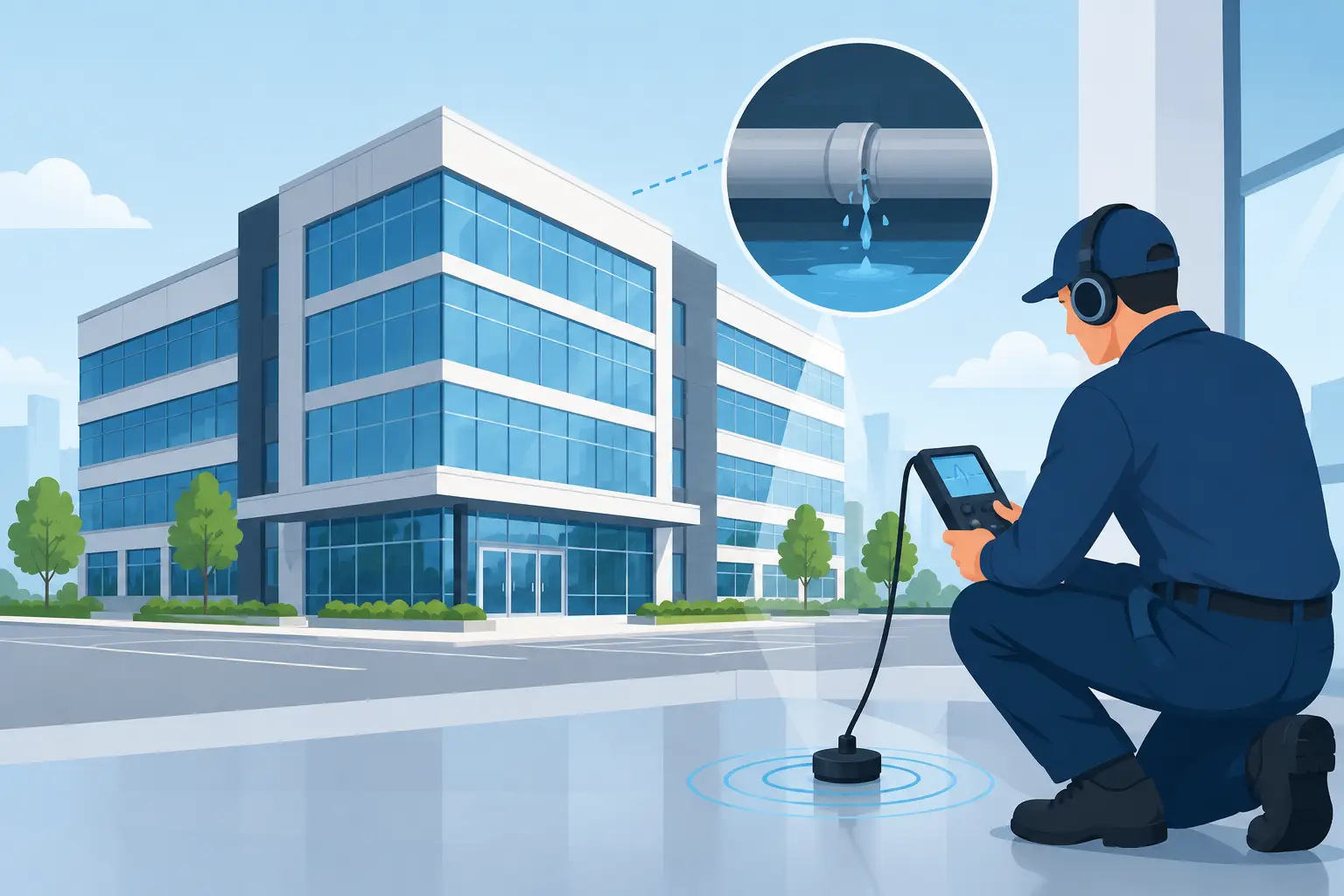
Non-destructive testing methods can then help confirm the source without opening large sections of wall, ceiling or concrete unnecessarily. Acoustic equipment may identify the sound of pressurised water escaping from pipework. Thermal imaging can reveal temperature differences associated with moisture or leaking hot-water lines. Moisture meters establish how far water has travelled through surrounding materials, while pressure testing can confirm whether a particular section of pipework is losing integrity.
For underground services, specialist tracing and targeted excavation may be needed. The point is not to use every available tool. It is to select a method that produces a defensible diagnosis with the least disruption to the property.
The areas that deserve closer attention
Some failures are easy to miss because they sit outside the daily sightlines of site teams. Others are overlooked because the symptoms are blamed on cleaning, weather or tenant behaviour. Facility managers should investigate promptly when they see several related signs, including:
- unexplained increases in water use or after-hours meter movement;
- recurring ceiling stains, bubbling paint or musty odours;
- persistent loss of water pressure in one part of the building;
- wet ground, unusually green turf or pooling near buried services; and
- repeated activation of pumps, hot-water systems or water top-up equipment.
Plant rooms are a common source of slow leaks, especially around valves, flexible connectors, pumps, pressure-reducing valves and storage tanks. Roof spaces and ceiling voids also deserve attention where air-conditioning condensate lines, hydraulic services and roof drainage run close together. A blocked drain can be obvious during heavy rain, but a poorly graded pipe or failed joint may only show itself through gradual staining.
Irrigation systems are another frequent source of hidden waste. A broken lateral line, faulty solenoid valve or controller issue may run outside business hours and remain invisible until landscaping becomes waterlogged. On larger sites, separating irrigation metering from building supply can make these faults easier to identify and manage.
Detection technology is useful, but diagnosis matters more
Remote water monitoring and smart meters can provide a strong early-warning layer for commercial assets. They can identify unusual flow patterns, overnight consumption or sudden spikes that warrant investigation. For portfolios with multiple sites, this visibility can help managers prioritise attendance before a tenant reports damage.
However, monitoring does not repair a fault or explain its cause. A meter may show constant flow, but the leak could be a failed toilet cistern, a burst irrigation pipe, a leaking mechanical service or unauthorised water use. The data needs to be paired with site knowledge, trade capability and a clear response process.
There are trade-offs to consider. Installing permanent monitoring across every small asset may not be commercially justified, particularly where water use is low and services are simple. In contrast, high-occupancy buildings, health and public facilities, industrial operations and sites with known underground infrastructure can benefit significantly from continuous monitoring and defined escalation thresholds.
The most practical approach is risk-based. Start with assets where a leak would create high disruption, safety exposure, water loss or repair costs. Use consumption data and maintenance history to decide where additional sensors, sub-metering or scheduled inspections will deliver value.
What a proper response looks like after a leak is found
Once the source is confirmed, the immediate priority is containment. This may involve isolating a valve, shutting down a local service, protecting nearby electrical equipment and arranging drying or cleaning where required. In occupied buildings, communication matters just as much as the technical fix. Tenants and operations teams need to know what is affected, how long the work will take and whether amenities or access will be restricted.
The repair scope should address the condition of the failed component and the surrounding system. Replacing one corroded fitting may restore service, but it may not be a durable solution if similar fittings across the same line are reaching end of life. Likewise, repairing damaged plasterboard before moisture levels are confirmed can create repeat work and conceal further deterioration.
A useful close-out record documents the leak location, cause, repair method, affected materials, test results and any recommended follow-up works. This gives building owners a clearer basis for capital planning and helps avoid repeating the same reactive cycle. It also supports accountability where common-property services, tenant areas and multiple contractors are involved.
Turning leak detection into planned maintenance
The best leak response is often the one that never becomes an emergency call-out. Planned plumbing maintenance should include routine inspections of accessible valves, pumps, flexible connections, tanks, amenities, roof drainage and irrigation components. Assets with a history of failures should be tracked rather than treated as isolated jobs.
Condition-based planning is especially useful for ageing commercial properties. Rather than waiting for repeated ceiling leaks or water damage, managers can schedule targeted replacement of high-risk pipe sections, upgrade ineffective isolation valves or refurbish tanks and associated fittings during quieter operating periods. This reduces disruption and provides more control over scope, access and budget.
TWS Service & Solutions approaches water management as part of wider asset reliability. Plumbing faults often overlap with roof drainage, waterproofing, electrical risk, landscape irrigation and building access requirements. Coordinating those interfaces under a tailored maintenance plan reduces the chance that one unresolved defect creates a chain of avoidable work.
Make the next investigation easier
Accurate service drawings, labelled isolation valves and current asset registers can save hours during a leak event. Where drawings are incomplete, each investigation is an opportunity to improve the record. Photograph valve locations, note shut-down impacts and capture the condition of concealed services when access is available.
A leak is disruptive, but it also provides useful information about how a building is ageing. Treat that information as a maintenance decision, not just a repair invoice. The right investigation and follow-up plan can protect tenants, control water waste and give the asset a longer, more reliable working life.